Monday, March 19, 2012

Prayer in action


Lenten Meditation 19 March 2012

            “The entire biblical text would emphasize ‘right relationship’ much more than being intellectually ‘right.’ Some call it orthopraxy or ‘right practice.’  Jesus consistently declares people to be saved or healed who are in right relationship with him, and never grills them on their belief or belonging systems.”  (Page 110)

  •  Saint Francis Sermon to the Birds in the Upper Basilica in Assisi
  •  Giotto di Bondone
  •             I spoke in an earlier essay about being a clerk in a battalion chaplain’s office when I was in the Marine Corps in the mid-1960’s.  One of the Chaplains for whom I worked was an Orthodox Chaplain, specifically a member of the Carpatho-Russian Greek Catholic Orthodox Church of North and South America, although he normally introduced himself as Russian Orthodox.  I learned a great deal from Chaplain Radasky about the Orthodox Church, including iconography, positive and negative understandings (cataphatic and apophatic theology to be exact), liturgical practice, vestments, and the various cultural understandings of Eastern Orthodoxy.  When I hear Episcopalians/Anglicans—and others belonging to Protestant groups—talking about being orthodox, I often get more than a little annoyed.  I have even asked on occasion to which of the Eastern Orthodox Churches they have changed their membership.  Now I understand that I am being a bit exclusivist with my own understanding—dare I say orthodox—but orthodox has become one of the contemporary purity codes against which Father Rohr warns. (p. 105) Modern use of the term orthodoxy generally implies a particular way of interpreting Scripture to separate out those who understand such issues as human sexuality, women’s ordination, atonement, and salvation in what is often termed a “liberal” understanding.  If one can claim orthodoxy for oneself, then anyone who disagrees with any position is obviously “heterodox” or heretic or apostate or any other term that can divide or set them apart as unworthy of relationship.

                My reading of Scripture, both the Hebrew and the Christian Scripture, draws me into relationship with God who is willing to come into my life, not once but repeatedly—dare I say constantly—to draw me into God’s nearer presence and life.  It doesn’t seem to matter what I believe or how I exercise my belief patterns, God continues to call me into a way of living that proclaims to the world the life of Jesus the Christ.  Looking at the Baptismal Covenant, (Book of Common Prayer pages 304-305) our belief system is articulated in the first three questions of belief contained in the Apostles’ Creed (orthodoxy) which is followed with five questions concerning the living out of our beliefs (orthopraxy).  They make up a unity that cannot be separated, even though we sometimes try to emphasize one aspect/question over all the others.  Episcopalians are experts at ignoring the command to “go out into all the world, making disciples…” (Matthew 28:19) and being witnesses “to the ends of the earth.” (Acts 1:8)  We are happy being good examples, but please don’t anyone expect me to talk about my faith or how God has worked in my life.  We are more than delighted to tell our friends about a wonderful new restaurant we have found, but we are resistant in speaking to them of the food of Life.  We gush with enthusiasm to friends over a book that has changed a perspective on family life, but will not say a word about how Scripture draws me into deep relationship with God.  We speak readily of how the music on a CD moves me emotionally, but we won’t utter a word about God’s miraculous presence in our lives that sings with life and love.

                For some months, the members of the Standing Committee and the Executive Council have begun their meetings with what is widely known as African Bible Study.  We also as a diocese experienced this method at our diocesan convention in November 2011. For those who are not familiar with this method, it proceeds like this:  if the group is larger than 8-10 the larger group is divided into small groups of 3-4. A chosen portion of Scripture is read by one of the group with discussion answering the question, “What word or phrase stood out for you today?”  After a few minutes the same passage is read again by another member of the small group and the discussion focuses this time on the question, “Where is the Good News?”  Again after a few minutes of discussion, the passage is read a third time by yet another person and the conversation focuses on “What is this passage calling me to do?”  We set the stage for our conversation and deliberation as leaders of the Episcopal Diocese of Fort Worth by centering our gathering time on Scripture, knowing that we are being called by any passage—every passage—to action and not just belief. 

                On Saturday past, at the beginning of the Executive Council meeting in Wichita Falls our passage was the Epistle lesson for Sunday, Ephesians 2:1-10.  There was a phrase that grabbed me that I had never noticed before: “children of wrath”.  (I argued that it had been inserted overnight into Ephesians because it had never registered on my brain.)  I meditated on that phrase for more than just the few minutes of Bible Study on Saturday.  At the discussion of the third question, my action focus was on letting go of my anger, but in the ensuing days I have kept coming back to that phrase.  Yes I need to let go of my own personal anger, but perhaps more importantly, when  I see the wrath exhibited around me I believe now I am challenged to step into the path of wrath and absorb it with God’s love, not following my instincts to react in kind, but praying through the anger until it is defused.

                Rohr’s book carries the title Things Hidden, Scripture as Spirituality.  His understanding of spirituality is not just pious prayer but prayer in action, not surprisingly a thoroughly Franciscan way of living.  It is also the path of Jesus.  He never allows His disciples to remain simply students sitting at His feet; Jesus calls us all into apostolic action, carrying the Good News with us always and proclaiming it constantly.  Or as St. Francis is reputed to have said, “Preach always; use words when necessary.”
                

    Friday, March 16, 2012

    Concerning pain


    Lenten Meditation 16 March 2012

                “Not that enlightened people must be rejected, but it is true that wounded and rejected people have a much greater chance of seeing clearly and having something to say (they also have a greater chance of being bitter!).  But Jesus still sends his followers to that place, because wisdom emerges from what you do with your pain!  It is a unique and needed perspective, as poets, artists and seers have always understood.  In fact, I would find it hard to understand all of the beatitudes in any other way (see Matthew 5:1-12).”  (page 101)

    Job on dungheap (from the Admont Giant-Bible, ca. 1140) 

                Chapter five purports to be all about power—both good and bad.  Richard Rohr, however, enters into a conversation concerning pain, a seemingly tangential focus.  His discussion concerns how individuals and communities ultimately deal with pain and suffering, whether it is from physical causes, rejection, failure or any other source.  Another way of understanding what the quotation is pointing toward is that in pain, human beings are able to focus on what is most important, making first things first, or as a friend of mine from many decades ago used to say, “to stop majoring in the minors.”

                Those who have never experienced pain in any form are less likely to be able to understand it or even come close to one who is in pain.  Sickness, and the attendant pain, can be an extremely uncomfortable situation for human beings.  Too often I have heard parishioners say they didn’t want to visit someone who is seriously ill, perhaps even terminally ill, because they don’t know what to say.  And I must say that in that discomfort we sometimes babble and say the “wrong” thing.  I am certain that everyone reading this meditation has some knowledge of the character Job.  Some may not know the whole story, and if you do not, I recommend a good reading of the Book of Job.  After he has been inflicted with boils, a condition which renders him a leper because of oozing sores, Job goes out of the city to sit on the sewage pile (dung heap) and to reside there.  He has three friends, Zophar, Elephaz, and Bildad, who come from a great distance to visit him, having heard of the calamities with which he has been afflicted (including losing ALL of his children, his wealth and his health).  From a distance they see his misery and as they approach, they internalize his pain to such an extent that they remain silent for seven days, simply sitting with Job.  After seven days they produce more pain with their words and arguments.  Each asks in long poetic discourses what Job has done, how Job has offended God, to bring this suffering upon himself.  To each Job replies, “Nothing, I am innocent.”  His “friends” will have none of that and continue to batter Job with their accusations.  Job finally becomes so angry that he does accuse God of not understanding, to which God replies, “Where were you when I laid the foundations of the world?” (Job 38ff)

                There is much to learn from Job’s friends.  When I have been a part of the training of Stephen Ministers—or others doing much the some sort of visitation ministry—I have always cautioned against talking too much, rather listening and as we like to say “empathizing” with the other.  The ministry of presence is heightened by our own ability to grasp another’s pain by knowing how we have suffered in some form and at some depth.  I have never been diagnosed—at least not to date—with a terminal illness, but I know the pain of failure, rejection, and illness.  When I am able to access those feelings and memories, I can grasp at least a bit of the other’s fear, loss, and suffering and sit with them, perhaps weep with them, knowing that God is present and suffering alongside them.  My goal is to be present. The operative word is be, not do. 

                I remember a person who was seeking ordination who was asked at a conference where we explored with the aspirants their experience and understanding of ministry (it was called BACAM, but I can never remember what each of the letters of the acronym stood for).  This person was asked when he had failed at something.  He pondered for a while and said he had never failed at anything.  Many of us knew that he had failed to complete two areas of study, he had had a failed marriage, and there were other areas that were problematic.  He was not recommended for postulancy, because the team felt he would never be able to grasp the pain and suffering of others until he could come to grips with the pain in his own life.  He reminded me of Job’s friends.

                Pain and suffering, regardless of the cause—be it illness, death of a loved one, our own impending death, accident, termination from a job, financial woes, divorce—can, and I say can, help us to prioritize our life in a healthy manner.  As Rohr says, it can also make us bitter.  By seeking priorities, we have the opportunity to focus on the true first things and let some of the niggling “stuff” go. 

                I do not encourage anyone to go out and seek pain just to be able to relate to others better; but I do encourage everyone to think back to those time that have been painful.  Some have experienced bullying in childhood or youth, some have suffered from illness that was debilitating, even if now recovered; some have lost loved ones who were close.  Whatever your life experience, it is worth recalling those times to see in retrospect where God was present in order to look for God’s presence in the present.  Lent is a great time to reflect; let this be a part of your reflection, not just so that you can rejoice in knowing God’s presence more thoroughly, but in order to proclaim God’s presence to others now.  How else are we going to “proclaim by word and example the Good News of God in Christ?”

    Thursday, March 15, 2012


    Lenten Meditation 15 March 2012

                “A prime idea of the Bible is its very straightforward critique of power, from Genesis to Revelation.”  (page 85)

              
    Caiaphas questions Jesus, by Matthias Stom 

               From the very beginning of his book Things Hidden, Scripture as Spirituality, the author Richard Rohr had posited that there are themes, or as he calls them dots, that connect the entirety of Scripture from the beginning to the end.  A long time priest friend who grew up Southern Baptist uses an expression for the whole Bible that I dearly love: he speaks of everything from “Genuine Morocco to maps.”  I was listing to him teach many years ago when he said that and I had to ask for clarification.  He explained that many Bibles are leather bound, and on the front cover is printed, often in gold leaf, “Genuine Morocco”.  Then he asked me, “And where do you invariably find the maps?”  I replied, “At the very end.  Oh, now I see.”


                Rohr takes this theme—or dot—of critique of power and builds chapter 5, entitled good power and bad power.  His discussion of power may make some readers uncomfortable and others angry.  Jesus does the same thing when he challenges the powers that be in his own culture and time: the Sadducees, the Pharisees, the Scribes who are all trying to put Jesus in his place with both subtle argument and direct confrontation, leading finally to Jesus’ crucifixion.  Even the Roman Imperial government comes under Jesus condemnation when he refuses to meet the power of government in a quid pro quo fashion by calling down the army of angels to dominate and defeat Pilate, Herod, and finally the Emperor in order to save his own life.  At his so-called trial before Pilate, the governor asks Jesus, “Are you the King of the Jews?... Jesus answers, ‘My kingship is not of this world….” (John 18:33-36)

                Part of the problem that we continue to wrestle with is the power of this world versus the power of God’s kingdom.  When all is well with the world, at least in my little corner of the world, I am quite happy to rely on God and to put my “whole trust in his grace and love” as we promised in our Baptismal Examination.  When life is chaotic or I am experiencing the attacks of either the Enemy or other human beings, sometimes both at the same time, I tend to want to rely on and exercise what Rohr calls “dominative power” which he describes as “the ability to influence events or others through coercion, punishment, threat, money, the power of my role or any other external force.”  This is what our author calls “bad power.”  Jesus life and witness, throughout his life is the exemplar of “good power.”  From the Garden of Eden to the present day, God could have chosen at any point to overwhelm us human beings with force to make us behave properly, including annihilation of the entire created world.  However, God chooses to be a God who reveals God’s self as “a God who is willing to wait, allow, forgive, trust and love unconditionally.  (page 89)

                My challenge continues to be how I use power.  Do I act out of fear, thus dominating others including my family, those with whom I work, the members of the diocese? Or am I willing to put my need for control into neutral and make my primary focus relationship and reconciliation.  I believe the latter is Jesus’ image and that to which He is calling us.  If indeed Scripture is to become spirituality for me I need to work continually on that as a growing edge which will take the rest of my life to hone.  Lent is our yearly opportunity to reflect on our relationship with God who is not punitive, threatening and coercive but forgiving and who loves unconditionally—even me.  I encourage you to reflect on your own use of power—good and bad—and set as discipline for the remainder of Lent, or as 12 Step programs say “Just for today”, a reflection on how you relate to others.  Then go back to the Liturgy for Ash Wednesday and pray through the Litany of Penance once again.  Accept the forgiveness which God is offering, forgive yourself, and then begin the difficult task of forgiving others.  May your day be filled with God.

    Wednesday, March 14, 2012

    "I am with you always . . . "


    Lenten Meditation  14 March 2012

                   It seems this is more than enough for God to create the yeast and the critical mass that God needs to unfreeze and save the world. ‘The whole batch is holy if the first handful of dough is holy’ as Paul says (Romans 11:16).  We rub off on one another because true spirituality is always contagious.”  (page 84)            

    Jesus Appears to the Disciples, Congregational Church of Austin, UCC

                   “In polite company one never speaks about religion, politics, or sex.”  That was a mantra with which I was raised, and there are probably a fair number of those who are reading this, particularly if you grew up in the Episcopal Church, that heard the same or a similar “rule”.  Of course, there is a quite valid reason for never discussing any of those subjects:  it is far too easy to fall into argumentativeness with politics; if when speaking of religion one might become arrogant and make others seem to be wrong; and sex is just plain embarrassing.  The mantra really came out of the Victorian Era of what we now believe to be total repression of the human psyche.  I was in a conversation recently with someone who had not heard that sentence but was talking around it.  When I quoted my mother, she said, “Then what is there to talk deeply about?”

                   Episcopalians have always—at least in my lifetime--been uncomfortable talking about our faith.  Unlike some of our Evangelical brothers and sisters who have been raised with personal witnessing within the worship service, our experience was to be at worship alone with God, supposedly ignoring the fact that there are others in the same space with us.  “It’s God and me and no one else.”  That is why the introduction of “Passing the Peace” was so uncomfortable; Episcopalians had to admit that there were others in the church with them.  Before I began to be an acolyte at about age 7, my mother chastised me when I would look around, and especially when I watched the other parishioners returning to their pews from the communion rail.  “This is not a time for watching others; it’s a time to be alone with God,” she would say, suggesting I should bow my head and close my eyes.  Children (and adults when we are willing to admit it) are curious about our surroundings and want to see who all is with us.  We really do want to know that we are not alone, but that we are part of a community of worshippers.  And yet we are extremely cautious—embarrassed—about talking to one another about the incredible experience of being in relationship with God. 
     
                   As Jesus is about to ascend, he gives his 11 disciples their final marching orders including a promise.  “Go therefore and make disciples of all nations, baptizing them in the name of the Father and of the Son and of the Holy Spirit, teaching them to observe all that I have commanded you; and lo, I am with you always, to the close of the age.”  (Matthew 28:19-20)  He does not tell the eleven to go hole up in some house so that they will be safe; he orders them to get out of their protective shell, take some risks, and bring others into the beautiful relationship with the Living God that they have experienced.

                   I remember vividly when the “Decade of Evangelism” was proposed in the 1980’s the reaction of many of the congregation I served in Norman, which mirrored much of the Episcopal Church.  We were aghast that we might be forced to go door-to-door passing out tracts or to stand on a street corner asking if passersby were saved.  That seemed to be the only expression of evangelism that was possible.  Even today we forget that one of the questions of the Baptismal Covenant asks, “Will you proclaim by word and example the Good News of God in Christ?”  We promise in our response, “I will, with God’s help.”

                   I am convinced that part of the reason the Episcopal Church—and every other main-line Christian group—continues to decline in numbers is that we are not willing to be “witnesses,”  the term Jesus uses for his disciples (Acts 1:8), to the grace, love and mercy of God in our own lives.  Everyone in the US knows, because we have seen enough lawyers on TV, that witnesses can only testify to what they have seen and heard or they will be challenged for giving hearsay testimony which is inadmissible.  I can only be a witness to my life in Christ, to the miraculous deeds that I have seen and experienced, to the transformation that has occurred in my life.  Why am I so reticent to share God’s love?  Could it be that I am too timid?  Now is the time for all of us to pray for the courage to allow our deep spirituality to “rub off” on others and take those baby steps of sharing how the Good News of God in Christ is alive in me.  Begin with a trusted friend who you know will not ridicule you and practice until you are comfortable enough to speak to someone not so close.  God will give you the opportunity; remember Jesus’ last words in Matthew 28:20, “Lo I am with you always…”

    Tuesday, March 13, 2012

    Mercy


    Lenten Meditation, 13 March 2012

                “We, indeed, have been given a God who not only allows us to make mistakes, but even uses our mistakes in our favor!  That is the gospel economy of grace and is the only thing worthy of being called ‘good news and a joy for all people’ (Luke 2:10).”  (Page 84)

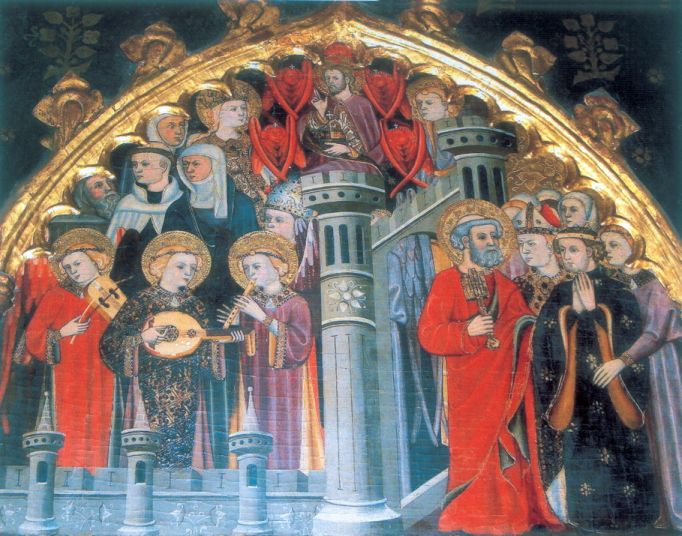
    Altarpiece of the Nativity, St. Peter and Musicians at the Gates of Heaven (ca 1405), Pere Vall. Cardona, Spain: Iglesia de San Miguel 

                I forget far too often that grace is not available to me only when I am “good” but especially when I have really blown it.  The pre-teen child that lives in my head is still wrapped up in the fairness issues of what is right and wrong, but God’s Grace has nothing to do with fairness.  I once heard Bishop Bill Frey say, “If you have the chance to pray for only one, pray for mercy, not fairness.”  That is exactly what Grace is about.  If left to our own devices to earn a place at God’s table and in God’s kingdom, we fail miserably.  Law is about pointing a way to right living, moral behavior; but law teaches us that we cannot ever be perfect in applying law in our own lives. 

                Father Rohr makes the point that St. Paul argues that law was given by God as a way for us to discover our failure in order for God to make God’s grace, mercy and love available to us who are unworthy of any grace, mercy or love.  If law could make us “worthy” we would have absolutely no use for Jesus’ life, death, resurrection, and ascension.  Nor would the Holy Spirit be available—or even necessary—in living into the life God has prepared for us in God’s kingdom.

                The Liturgy for Ash Wednesday is a powerful reminder that we do not come before God relying on our own righteousness, as did the Pharisee in the parable of the “Pharisee and the Publican.” (Luke 18:9-14)  There is a wonderful story of a man who has been a faithful Christian all of his life.  When the man dies he is met at the gates of Heaven by the keeper of the keys, St. Peter, who informs the man that in order to enter the kingdom he must have earned 100 points in his life.  The man feels fairly confident and begins by telling St. Peter of his perfect attendance in Sunday School all 12 of his school years; and besides that he taught the junior high class at his parish for 35 years.  St Peter replies, “How wonderful!  That’s one point.”

    Now the man is a bit perplexed, thinking teaching junior high students should count for at least 10 points.  So he continues, “My wife and I were married for 53 years, and never once was I unfaithful.  We raised our children to be faithful Christians, and their children are following in those same footsteps.”  St Peter says, “That’s even better!  Now you have two points.” 

    Beginning to sweat a bit, the man says, “I began to tithe when I was 7 years old and never failed to give at least 10% of all of our total income.  In addition, I managed the Every Member Canvass for 36 years, each year raising more than the stated goal.  I also chaired the capital campaign which raised almost twice the needed funds.  And I insisted that the overage be put into an endowment fund to finance outreach locally and globally.”  “Now you’re really talking!!  You have three points,” replies Peter.

    The man is almost frantic and begins to blurt out, “I never passed by anyone asking for assistance, even those who I knew would spend it on drink.  I worked in the homeless shelter at least one evening a week for my entire adult life.  I started the food pantry that feeds thousands each month and personally donated both goods and money.  We travelled to Navajoland and helped start a mission near Window Rock, and we funded it for many years.  I also did everything I could to encourage outreach across our diocese and formed the first international outreach mission in Uganda.”  “Wow!  That’s really something.  Now you have four points.  You only have 96 points to go.”

    At a complete loss, thinking all of that would be worth more than 4 points, the exasperated man says, “Well, I can’t think of anything else.  I guess without the grace of God I go to Hell.” 

    “That’s 96 points.  Welcome home!”

                “If you can only pray for one, pray for mercy not fairness.”

    Monday, March 12, 2012

    "The power of me first"


    Lenten Meditation  12 March 2012

                “Now the definition of sin that many of us were given was ’a thought, word or deed contrary to the law of God.’  The requirements for sin were three: (1) you had to have full knowledge; (2) it had to be a grievous matter; (3) you had to give it full consent.… but actually  it’s not a definition of biblical sin at all; it’s a juridical definition of law.”  (page 78)


                Over 45 years ago I served as a clerk for a battalion chaplain when I was in the Marine Corps.  The first chaplain I served with was an Episcopalian who had just returned from a tour with Marines in DaNang Vietnam.  While he was at Quantico Virginia, Chaplain MacLean worked on occasion with several of the local Episcopal parishes in the area.  One Saturday he was working with 6-year-old children and asked them, “What is sin?”  The expected answers came out immediately:  “It’s when I hit my brother.”  When I don’t obey my mother.”  “When I do something wrong.”  But one child who had been very quiet at first spoke up and said, “It’s the power of me first.”  Since I first heard Chaplain MacLean report that story to me in 1966, I have yet to find a better definition of sin. 

                Father Rohr, the author of our study book Things Hidden, Scripture as Spirituality, takes an entire chapter to explore the question of sin.  Chapter 4 is entitled “The Boxing Ring”, which is an appropriate arena for discussion of law and Grace.  As does St. Paul, he delves into the argument of how law and Grace are connected and how one leads to the other.  In an earlier chapter Rohr discusses spiritual development which begins with “my story” --just me, which moves to “our story” --the tribe or community, and finally to “The story” or “the great patterns which are always true.”  That follows my experience with children who from birth to about age 7 live in an age of wonder.  At about 7 children move into a real beginning of understanding of self which is an age of black-and-white, right-and-wrong.  This is when we really begin to hear, “It’s not fair.”  Generally in early to mid-teen years, an understanding of abstract ideas begins to build about the same time a separate identity takes root.  Grace is very difficult for those in pre-abstract thought, because Grace violates the fairness principle.  How can someone who has done something completely wrong receive forgiveness?  It’s not fair.  That is the point of the parable of the “Man with Two Sons,” or as I prefer to call the story “The Prodigious Father.”  It is the basis of the teachings of Jesus.  It is the argument of St. Paul’s letter to the Romans.

                Most of us mature during our teen years to at least a rudimentary understanding of abstraction, and those of us who grew up in a worshipping family may have gotten some grip on Grace.  Even though we mature, and as some would say progress, most—maybe even all—of us retain something of the wonder of early childhood as well as the legalistic, right/wrong, good/bad, fairness focus.  Especially when we have been hurt by another, we tend to revert to a juridical desire to “get even” by seeing the other punished.

                Unfortunately, Christians are not exempt from desiring the pound of flesh from those who have hurt us.  Whether the “sin” has been a minor slight or a grievous matter, we tend to want to see heads roll, blood spilt, condemnation abound.  Most of us are amazed and stunned when we see forgiveness offered in dramatic situations such as happened a few days ago when the mother of one of the teenagers killed at the school in Ohio forgave the shooter, or when an Amish community reached out to the family of a man who had killed about 20 children and then took his own life.  How can they do that? 

                As long as I remain in the position of non-forgiveness, am I not acting/reacting in a “me first” pattern?  If this is all about me, am I not as guilty of sin as the one who has sinned against me?  Am I willing to allow God’s Grace to penetrate into my soul and touch me?  Am I willing to pray “Forgive me my sins only as much as I am willing to forgive others?”

                Lent is a wonderful time to reflect on how we both accept God’s love, mercy and grace and offer it to those around us.  How can I take one baby step today by offering my forgiveness, my love, my mercy to one who does not deserve it?  Remember, it took most of the great saints of the past a long time to move toward an outward manifestation of that which had been growing in their hearts and souls.  Remember St. Peter and his repeated “failures,” including his denial of Jesus; remember his wavering over whether Gentiles should be part of the Christian community; but remember at his death he was willing to give his life for his Lord.  Baby steps today, but steps none the less.  

    Friday, March 9, 2012

    Staying in relationship


    Lenten Meditation 9 March 2012
                “It doesn’t have to do with being perfect.  It has to do with staying in relationship, holding onto union as tightly as God holds onto you, staying in there.  The one who knows all and receives all, as a mirror does, has no trouble forgiving all.  It’s not a matter of being correct, but of being connected.”  (page 67)

    The Holy Trinity, painted by Andrei Rublev

                I don’t need church; I can worship God in the forest (or golf course, or at home, or wherever) just as well, and I don’t have to put up with all the hypocrites.  I am sure some of you have heard someone say something like that; perhaps you have even said it yourself at some point in your life.  There have been moments that I have felt that way, but blessedly God has drawn me back into the arms of the community.  Yes indeed there are hypocrites in every congregation, and you and I might be the biggest hypocrites from time to time.  Salvation and redemption, however, are not about being sinless—or hypocrite-less—before we approach God.  It is about being a part of a community that is working together to discover God’s call on our life and living that out as completely as we can.

                One of the foundations of Christianity is the theology of the Trinity.  Now the word “trinity” never appears in either the Hebrew or Christian Scriptures, but there are pointers to the community and communion of God within God’s self.  “Let us make human beings in our image.” (Genesis 1)  The story of the three travelers—the Lord--that appear to Abraham and relate once again the promise that Abraham will be the father of many nations, and, in fact, his wife Sarah will bear a child in the coming springtime.  (Genesis 18)  And there are many other examples in the Hebrew Scriptures.  In the Christian Scriptures the examples are far more explicit:  John’s Gospel is replete with references to the Father and to the Paraclete/Holy Spirit/the Advocate with Jesus referencing himself as the Son. 

                Are we then worshipping three gods or are we indeed monotheistic?  The Jewish equivalent to our creedal statements, the Shemah, begins, “Hear O Israel, the Lord our God, the Lord is one.”  It took the early Church 450 years to work out how we could articulate our understanding of One God in Three Persons, separate and distinct, and yet a unity.  Perhaps the most famous attempt to describe this three-in-one God came from St. Patrick, the patron saint of Ireland.  I am sure you are aware that shamrocks are always associated with Patrick, but most Americans do not know why.  As Patrick was evangelizing the Irish Celts, he was challenged on the concept of the Trinity.  He is reputed to have bent down and plucked a shamrock, held it up and showed the three blades but only one shamrock all of the same substance, different, but the same.  Some modern day Christians have used water in much the same way--ice, liquid, and steam—but there are theological difficulties with this metaphor.

                My favorite representation of the Trinity is a Russian Orthodox icon painted by Andrei Rublev in the early 15th century. [Above] It shows the three visitors to Abraham at the oaks of Mamre, but clearly it represents the Father (left) the Son (center) and the Holy Spirit (right) seated at a table but with the fourth side closest to the viewer vacant inviting the viewer into the icon to commune with God.  A meditational description of this icon is available through Google if you are interested.

                We are called as Christians into a community of believers, not perfect, sometimes hateful to one another, all sinners, but seeking together to re-present the community of the Trinity to this world.  It is only through community that we are able to discover our true selves and to grow into the full stature of Christ.  Every Christian is different, we were not produced by a cookie cutter to all look the same and have the same abilities and gifts.  St. Paul speaks to the concept of the differences of the various body parts in I Corinthians 12 and how no part of the body is more important than any other, but that all are necessary to function in a healthy manner. 

                Yes it is possible to worship God in the mountains; I have done that myself.  But it is a poor substitute for praying in the community of believers.  Yes God is occasionally mentioned on the golf course, but not often in a prayerful manner.  Yes one can worship God at home alone, but there are too many distractions there; and in addition the community is not present to uphold edify and challenge.

                As Father Rohr says, it’s not about being correct or perfect, it’s about being connected.  Through community and communion, two words with the same root, we learn to live into the community of God, the Trinity, which shows us that we cannot be “lone ranger” Christians.  Left to our own devices we will wander off on a path that will take us farther and farther away from God and alienate us from our brothers and sisters in Christ.  Sometimes our challenge is to be connected, but that is our call.  Pray for your community, your congregation; visualize one who is a challenge to you and pray that the love, mercy and grace of God may fill that person to accomplish God’s purpose.  Try that for a week and trust that God is changing you.